Qwen3.5-Omni: 10-Hour Audio, 4M Frame Video, SOTA in 215 Benchmarks
Qwen3.5-Omni: Native multimodal model with 256k context, 10-hour audio, 4M frame video support. Thinker-Talker + Hybrid-Attention MoE architecture achieves SOTA in 215 benchmarks.
Published 183 days ago. Content may be outdated.
Alibaba’s Qwen team just dropped another bombshell! On March 30, 2026, Qwen3.5-Omni was officially released, and this time it’s truly “omni-modal” — not only can it understand images, but it can also process 10 hours of audio, analyze 4 million video frames, and even write code while listening to music. What’s more impressive? It achieved SOTA in 215 benchmarks, completely outperforming Gemini-3.1 Pro.
Explosive Capabilities: 10-Hour Audio + 4M Video Frames — This is True Multimodal
When it comes to multimodal, many models talk the talk, but Qwen3.5-Omni actually walks the walk.
Core Capabilities Overview
| Capability | Specification | Real-world Scenario |
|---|---|---|
| Context Length | 256k tokens | Process ultra-long documents, entire codebases |
| Audio Processing | 10 hours continuous audio | Marathon meeting recordings, end-to-end listening |
| Video Understanding | 4M frames 720P (1 FPS) | A 2-hour movie, watch it all and write a review |
| Speech Recognition | 113 languages and dialects | From Mandarin to Cantonese, English to Arabic |
| Speech Generation | 36 languages | Multilingual voice output |
Technically, Alibaba used Thinker-Talker dual architecture + Hybrid-Attention MoE. Simply put, it separates “understanding” and “expression” — one handles comprehension, the other handles generation, combined with hybrid attention mechanisms for maximum efficiency.
Three Version Comparison
| Version | Positioning | Use Cases |
|---|---|---|
| Qwen3.5-Omni-Plus | Flagship | Most powerful, suitable for complex tasks |
| Qwen3.5-Omni-Flash | Balanced | Performance and speed balanced |
| Qwen3.5-Omni-Light | Lightweight | Fast response, low resource usage |
Performance Domination: SOTA in 215 Benchmarks, Gemini Completely Surpassed
Numbers don’t lie. Qwen3.5-Omni-Plus achieved SOTA in 215 datasets and benchmarks.
Performance Coverage
| Task Type | Benchmark Count | Description |
|---|---|---|
| Video Understanding | 3 | Video content analysis, scene recognition |
| Audio Understanding | 5 | Audio classification, event detection |
| Speech Recognition (ASR) | 8 | General speech-to-text |
| Speech Translation (S2TT) | 156 | Multilingual speech-to-text translation |
| Multilingual ASR | 43 | Multilingual speech recognition |
Comparison with Gemini-3.1 Pro
| Capability | Qwen3.5-Omni-Plus | Gemini-3.1 Pro |
|---|---|---|
| Audio Understanding | ✅ Fully Surpassed | ❌ Behind |
| Audio Q&A | ✅ Fully Surpassed | ❌ Behind |
| Speech Recognition | ✅ Fully Surpassed | ❌ Behind |
| Speech Translation | ✅ Fully Surpassed | ❌ Behind |
| Voice Dialogue | ✅ Fully Surpassed | ❌ Behind |
| Video Understanding | ✅ On Par | ✅ On Par |
| Text Capability | ✅ Qwen3.5 Level | - |
| Vision Capability | ✅ Qwen3.5 Level | - |
What does this mean? Previously, you might need three separate models for text, images, and audio. Now, one Qwen3.5-Omni handles everything, and each capability is top-tier.
Black Tech: Write Code While Listening to Music?
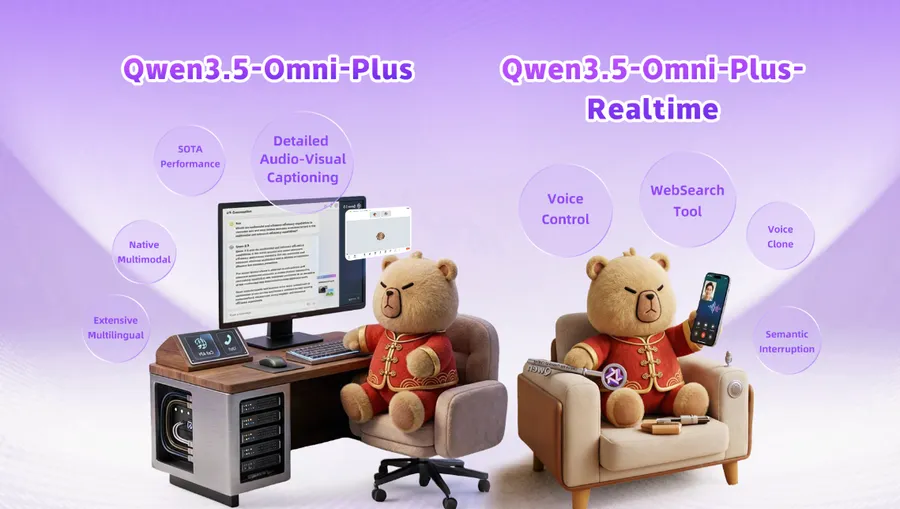
The most eye-catching feature is Audio-Visual Vibe Coding.
Simply put, you can use audio instructions to make AI write code. It’s not speech-to-text then execution — the model directly understands programming intent from audio and generates code. This is an “emergent ability” unique to multimodal models that single-modal models simply can’t achieve.
Additionally, Qwen3.5-Omni-Plus’s audio caption generation is incredibly powerful: it not only generates detailed audio descriptions but also automatically timestamps them, precise to every sound detail. This is a game-changer for video subtitle generation and audio content analysis.
Real-time Interaction: More Natural Than Human Conversation
Offline capability is one thing, but real-time interaction is where the real test lies. Qwen3.5-Omni’s Realtime mode maxes out the experience.
Realtime Mode Core Features
| Feature | Function | Actual Experience |
|---|---|---|
| Auto Turn-taking | Model decides when to speak and listen | Like chatting with a real person, naturally picks up conversation without interrupting |
| Native WebSearch | Autonomously decides whether to search | Searches for weather in real-time, answers common knowledge directly |
| Multi-turn Dialogue Control | Control speed, volume, emotion | Business style or casual chat, your choice |
| Voice Cloning | Upload voice sample to clone | Talk to AI in your own voice |
| ARIA Technology | Dynamically adjusts text and audio rhythm | Real-time and fluency combined, no stuttering or missing words |
ARIA Technology: Solving Speech Synthesis Pain Points
Traditional speech synthesis has chronic issues: missing words, repetition, weird characters, and frequent stuttering.
Alibaba developed ARIA (Adaptive Rate Interleave Alignment) technology, which dynamically adjusts text and audio element rhythm. The result: real-time performance and fluency combined — no stuttering, natural pronunciation, sounds just like a real person.
How to Use? Two APIs to Choose From
| API Type | Use Cases | Typical Applications |
|---|---|---|
| Offline API | Batch processing, deep analysis | Analyze full-day meeting recordings, generate detailed movie subtitles |
| Realtime API | Real-time dialogue, voice interaction | Smart customer service, voice assistants, real-time translation |
You can also customize the model’s speaking style, speed, and emotion through system prompts — whether you want serious business style or casual chat style, it’s up to you.
Technical Deep Dive: Thinker-Talker + Native Multimodal Training
Core Architecture
| Component | Function | Role |
|---|---|---|
| Thinker | Understanding Module | Handles comprehension of input content |
| Talker | Generation Module | Handles speech and output responses |
| Hybrid-Attention MoE | Hybrid Attention + Mixture of Experts | Maximizes both efficiency and effectiveness |
The key is native multimodal pre-training: instead of training a text model first then adding audio-visual capabilities, it trains on text, images, and up to 1-hour audio/video data together from the start. This is how emergent abilities like Audio-Visual Vibe Coding appear.
What Can It Do? Countless Scenarios
| Application Scenario | Core Capability | Real Value |
|---|---|---|
| Smart Customer Service | Multilingual real-time voice dialogue + voice cloning | 24/7 service with customer’s voice |
| Content Creation | Auto subtitle generation + audio description | Content creator’s blessing, saves massive post-production time |
| Education & Training | Multimodal teaching + voice interaction | Students ask by voice, AI answers by voice |
| Development Tools | Audio-Visual Vibe Coding | Write code while listening to music (not kidding) |
| Auxiliary Tools | Audio transcription + multilingual translation + video analysis | Meeting notes, cross-language communication, video content understanding |
Final Thoughts
The release of Qwen3.5-Omni marks a new stage for multimodal large models.
It’s no longer about “can process multiple modalities” to be called multimodal, but rather: each modality must be top-tier, and modalities must create synergy. Writing code from audio, generating subtitles from video, real-time voice dialogue without stuttering — each of these capabilities is strong individually, but combined they’re a dimensional strike.
More importantly, Alibaba didn’t just release the model — they also provided complete APIs and demos. Developers can get started immediately, no waiting.
The future of multimodal AI might come faster than we think.
For more technical details and usage methods, visit Qwen Official Blog and Demo Section.
More Articles