GLM-5.3 Is Here: The Base Model Stays, While Post-Training Scales Up
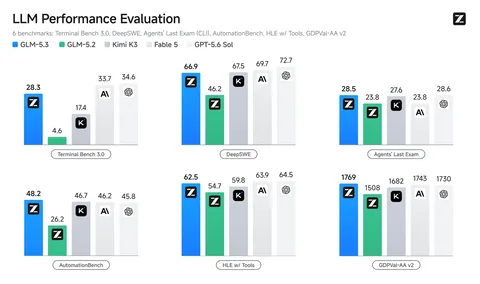
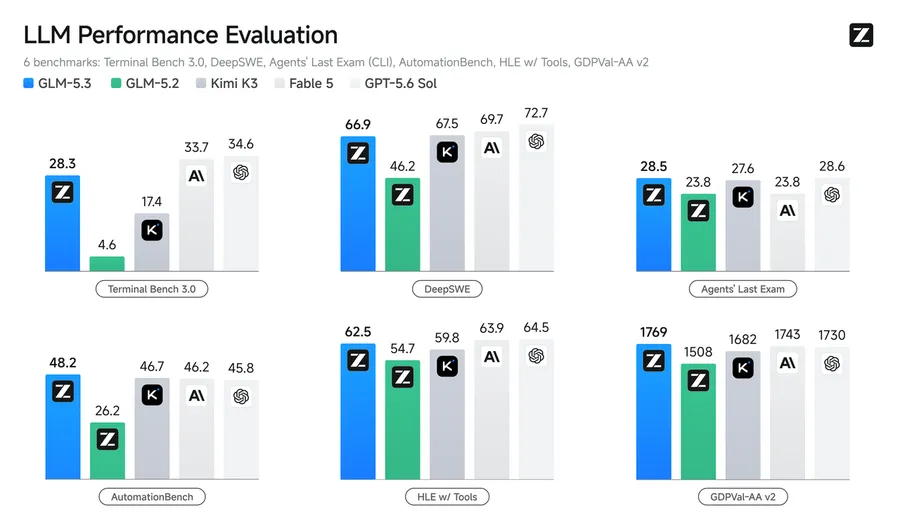
GLM-5.3 is here. Zhipu keeps the 744B-A40B base and scales up post-training instead, with a 1M context window, 128K output limit, 28.3 on Terminal-Bench 3.0, and 66.9 on DeepSWE v1.1.
Published 45 days ago. Content may be outdated.
GLM-5.3 is here. The first surprise is what did not change: Zhipu did not replace the base model with an even larger one. Instead, it put the emphasis on post-training, aiming to make the model do more than produce a few lines of code and actually carry a piece of work through to completion.
Zhipu says GLM-5.3 keeps the same base model as GLM-5.2, while expanding post-training into long-horizon task environments at dozens of times the previous scale. The model is not only asked to solve an isolated coding problem. It is trained to move through a more realistic engineering workflow: finding the problem, analyzing the approach, implementing it, validating the result, and delivering the work.
GLM-5.3 is now fully available in the GLM Coding Plan. The official documentation is equally clear that the model API is still “coming soon.” You can try it through the Coding Plan today, but developers cannot yet integrate it as a regular API model.
The Base Stays the Same. The Training Does Not.
GLM-5.3 is a flagship text model with a 1M-token context window and a 128K maximum output. It supports thinking mode, streaming, Function Calling, context caching, structured output, and MCP.
The GLM-5.3 page does not list a separate parameter count. It does state that GLM-5.3 and GLM-5.2 use exactly the same base model. Based on the specification for GLM-5.2 in the official GLM-5 repository, that MoE base has 744B total parameters and 40B active parameters.
So the main change in 5.3 is not a larger foundation model built from scratch. It is heavier and longer post-training:
- Long-horizon environments expanded to dozens of times the previous scale, with more varied task types
- Longer training cycles, including tasks comparable to several days of work by a senior engineer
- Access to real compute clusters, storage systems, internal documentation, and code repositories
- A training target that goes beyond solving a problem and covers the full engineering loop
The hard part is making the model keep going. Writing the first piece of code is not the same as finishing a project. The model still has to understand constraints, use tools, handle failures, run validation, and stay on track across a long context. GLM-5.3 is aimed at the part where an agent can start quickly, then gradually lose the plot.
How Much Did the Official Scores Move?
Zhipu’s GLM-5.3 technical page reports the following public benchmark results.
| Benchmark | GLM-5.2 | GLM-5.3 | Gain |
|---|---|---|---|
| Terminal-Bench 3.0 | 4.6 | 28.3 | +23.7 |
| DeepSWE v1.1 | 46.2 | 66.9 | +20.7 |
| Agents’ Last Exam | 23.8 | 28.5 | +4.7 |
The three benchmarks look at different things. Terminal-Bench 3.0 asks whether an agent can complete real tasks in a terminal environment. DeepSWE is closer to software repair and implementation. Agents’ Last Exam puts more weight on long-chain agent tasks. Zhipu says GLM-5.3 ranks first among open-source models on these public benchmarks and describes its coding and agent capabilities as comparable to “Claude Fable 5.”
Zhipu also reports a score of 1769 on GDPval-AA v2, covering 44 professions. This benchmark looks beyond pure coding questions and focuses on task completion in a broader set of professional scenarios.
Against Frontier Models on the Same Test
Zhipu has also published comparisons from its internal coding benchmark, Z.ai Code Bench. Its environments are designed to resemble real user workflows, measuring both task accuracy and the output tokens an agent uses to complete the work.
| Model | Reasoning level | Task accuracy | Average output |
|---|---|---|---|
| GLM-5.3 | High | 31.4% | About 50K tokens |
| Claude Opus 4.8 | High | 29.5% | About 120K tokens |
| GLM-5.3 | Max | 34.5% | About 75K tokens |
| GLM-5.2 | Max | 23.4% | About 96K tokens |
| Claude Fable 5 | Max | 39.5% | Not disclosed |
At the High setting, GLM-5.3 reaches 31.4%, ahead of Claude Opus 4.8 at 29.5%, while reducing average output from about 120K to about 50K tokens. At the Max setting, GLM-5.3 reaches 34.5%, while Claude Fable 5 records 39.5%.
Security Evaluation Is Another Focus
GLM-5.3 also comes with new cybersecurity evaluation results:
| Benchmark | GLM-5.2 | GLM-5.3 |
|---|---|---|
| CyberGym | 77.2% | 84.5% |
| ExploitBench | 24.4% | 54.4% |
For CyberGym, Zhipu lists Mythos 5 at 83.8% and GPT-5.6 Sol at 83.6%, compared with 84.5% for GLM-5.3. At least in this official result, security analysis and tool-chain coordination were clearly part of the training focus.
Zhipu places the current advantage at the front end of the vulnerability-exploitation chain, with deeper exploitation and complete offensive-defensive workflows identified as the next areas for improvement.
On the deeper ExploitBench comparison, GLM-5.3’s 54.4% remains below Mythos 5 at 78.0% and GPT-5.6 Sol at 76.5%. Another benchmark, ExploitGym, counts how many exploitation tasks a model completes within a fixed time budget. GLM-5.3 completes 105 tasks in two hours and 130 in six hours, compared with 29 and 39 for GLM-5.2. Mythos 5 reaches 181 and 247 respectively.
Taken together, the security results are more revealing than CyberGym alone. GLM-5.3 is already at the front on vulnerability discovery, but the gap with leading closed models becomes clear as the task moves deeper into a complete exploitation chain.
Why Focus on Post-Training?
As foundation-model scores keep rising, the difference developers actually feel is often no longer whether a model can answer a question. It is whether the model can keep working and deliver a usable result at the end.
Consider a coding agent fixing a production issue. It has to read the repository, locate the problem, edit files, run tests, inspect errors, and decide what to change next. As the task gets longer, two problems appear again and again: the reasoning is solid at the beginning but drifts later, or the agent makes a long chain of tool calls without ever converging on a deliverable.
GLM-5.3 uses longer task environments and longer post-training cycles to target this ability to “finish the job.” Zhipu says that, at a similar token budget, GLM-5.3 achieves a better balance between completion quality, execution speed, and cost, and summarizes the improvement in coding experience as roughly 50%.
How Can You Use It Today?
Users who want to try GLM-5.3 directly can access it through the GLM Coding Plan, where Zhipu says the model is fully available.
The model API is not live yet, and an independent GLM-5.3 weight download and model card have not been published. Pricing, limits, and developer access details will arrive with the API announcement.
The Bottom Line
The interesting part of GLM-5.3 is not a bigger base model. It is the decision to place the existing base model in longer, more complex, and more realistic work environments, then train it until it can handle more of the journey. The official scores show a clear change, particularly on terminal and software-engineering tasks.
The direction of this release is hard to miss: the competition among agents is moving from “can it write code?” to “can it finish the project?”
Sources:
More Articles