Claude Opus 5 Launches With 1M Context at Half the Price of Fable 5
Anthropic has released Claude Opus 5 for complex agentic coding and enterprise work, with 1M context, 128K output, and API pricing at half the cost of Claude Fable 5 today.
Published 66 days ago. Content may be outdated.
Anthropic has added Claude Opus 5 to its model lineup. Its API ID is claude-opus-5, and its target use case is clear: complex agentic coding and enterprise-grade work.
The most important detail is not parameter count. Anthropic still has not disclosed the model’s weight size. The real change is that Opus 5 gets a 1M-token context window, 128K maximum output, and default adaptive thinking, while staying in the Opus price band: $5 input and $25 output per million tokens.
In one line: Opus 5 brings stronger agent capability down into the Opus price tier instead of creating another more expensive Fable-class model.
30-Second Summary
- Model ID: claude-opus-5
- Positioning: complex agentic coding, enterprise knowledge work, multi-step tasks
- Input modalities: text and image
- Output modality: text
- Context window: 1M tokens
- Maximum output: 128K tokens
- Batch API maximum output: up to 300K tokens with a beta header
- Thinking: adaptive thinking, enabled by default
- Default effort: high
- Knowledge cutoff: reliable knowledge and training data cutoffs are both May 2026
- Parameter count: not publicly disclosed
Pricing: Opus 5 Does Not Move Into the Fable Tier
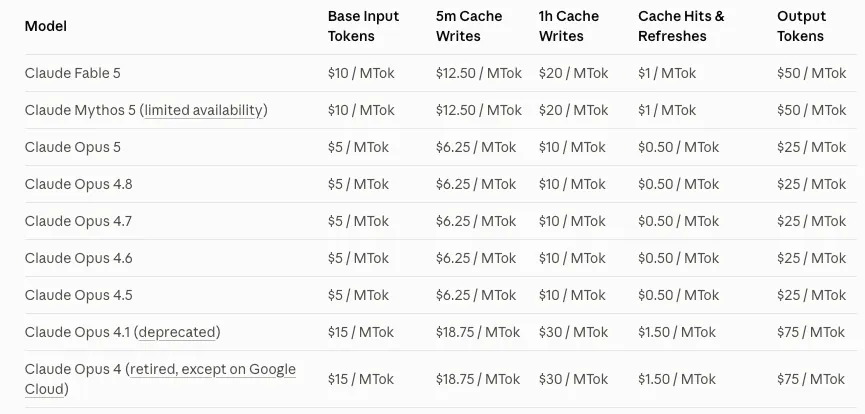
Anthropic’s official pricing lists Claude Opus 5 at:
| Billing item | Claude Opus 5 |
|---|---|
| Standard input | $5 / MTok |
| 5-minute cache write | $6.25 / MTok |
| 1-hour cache write | $10 / MTok |
| Cache hit / refresh | $0.50 / MTok |
| Output | $25 / MTok |
That keeps Opus 5 at the same base price as Opus 4.8, while making it half the price of Claude Fable 5. Fable 5 is $10 input / $50 output; Opus 5 is $5 input / $25 output.
For a rough workload of 1 million input tokens plus 200,000 output tokens:
| Model | Estimated cost |
|---|---|
| Claude Opus 5 | $10 |
| Claude Fable 5 | $20 |
| Claude Sonnet 5 promotional price | $4 |
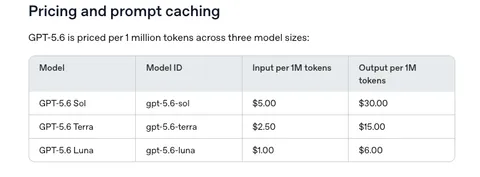
| GPT-5.6 Sol short-context price | $11 |
That puts Opus 5 close to GPT-5.6 Sol’s short-context standard pricing. Inside the Claude family, it looks much more like a daily high-end workhorse than a Fable 5 replacement.
How to Choose Across the Claude Family
| Model | Positioning | Input / output price | Context | Max output | Best fit |
|---|---|---|---|---|---|
| Claude Fable 5 | Strongest broadly available Claude model, long-running agents | $10 / $50 | 1M | 128K | Highest quality, long tasks, complex reasoning |
| Claude Opus 5 | Complex agentic coding and enterprise work | $5 / $25 | 1M | 128K | High-quality coding, enterprise knowledge work, long-running agents |
| Claude Sonnet 5 | Balance of speed and intelligence | $2 / $10 through August 31 | 1M | 128K | High-throughput and cost-sensitive production tasks |
| Claude Haiku 4.5 | Fastest and lowest-cost option | $1 / $5 | 200K | 64K | Classification, extraction, lightweight automation |
Anthropic’s guidance is direct: if you are unsure where to start for complex agentic coding or enterprise work, start with Claude Opus 5. If you need the strongest available capability, use Claude Fable 5.
That creates a practical selection rule:
- Highest quality: Fable 5
- Daily complex agents and coding tasks: Opus 5
- More cost-sensitive speed: Sonnet 5
- Large-scale lightweight tasks: Haiku 4.5
What Changes From Opus 4.8?
Opus 5 is not just a name bump. Several changes affect day-to-day developer experience.
1. Thinking Is On by Default
Opus 5 uses adaptive thinking, adjusting its depth of reasoning based on the task. For multi-file code changes, reviews, and complex document analysis, it behaves more like a model that actively allocates reasoning budget.
2. It Is Better Suited to Long-Running Agents
The 1M context window and 128K output limit let Opus 5 handle larger repositories, longer evidence packs, and more complete task trajectories. The Batch API’s 300K output ceiling also signals room for very long asynchronous jobs.
3. Pricing Does Not Climb With Capability
This is the commercial signal that matters. Fable 5 is the top capability tier. Opus 5 looks more like the high-capability daily tier. For teams, that means more complex work can move to Opus 5 without sending every task to the most expensive model.
Why the Parameter Count Should Stay Blank
The obvious question is: how many parameters does Opus 5 have?
For now, the answer is simple: Anthropic has not publicly disclosed it.
So articles, comparisons, and model tables should avoid invented trillion-parameter claims. Claude releases have historically emphasized capability, context length, output limits, pricing, and model behavior rather than public weight size.
For users, the verifiable selection data is:
- API ID
- context length
- maximum output
- input and output pricing
- thinking and effort behavior
- official recommended use cases
Those are the numbers that actually map to cost and product experience.
Conclusion
Claude Opus 5 is not framed as stronger than Fable 5. Its real move is putting complex agentic and enterprise capability into a more sustainable price tier.
It keeps 1M context and 128K output while costing half as much as Fable 5. For many developers and teams, Opus 5 may become the default high-end Claude model: stronger than Sonnet 5 for hard tasks, but much easier to use continuously than Fable 5.
Sources:
More Articles