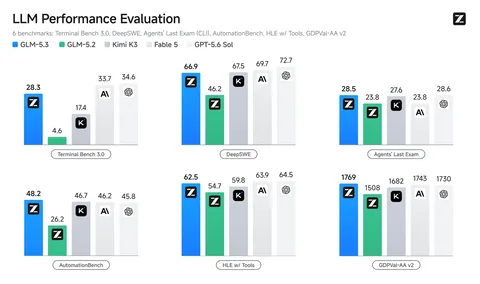
Ox Alpha Unmasked: Z.ai's GLM-5.3-Flash Clocks 44T Tokens
Ox Alpha has been identified as Z.ai's GLM-5.3-Flash. During its anonymous free preview, OpenCode logged 503K users, 13.12M completed sessions, 44T tokens, and a 10.6% share.
Published 54 days ago. Content may be outdated.
The model that had developers around the world guessing for days finally has a name behind it.
The anonymous Ox Alpha is Z.ai’s next GLM-series release, widely referred to as GLM-5.3-Flash. Bloomberg reported Z.ai’s confirmation and its plan to release the model weights that evening.
The more interesting story is what happened before the reveal. Ox Alpha arrived without a launch event, parameter chart, or model card. It appeared on OpenRouter as stealth/ox-alpha, free to try, then landed inside OpenCode’s real coding workflows. Developers threw private projects, terminal tasks, and long-context jobs at it. The identity puzzle quickly turned into a massive real-world stress test.
As of August 26, OpenCode’s public dashboard showed 503K unique users, 13.12M completed sessions, and 44T tokens processed by Ox Alpha. Its token share had reached 10.6%.
This was not a passing trend. Developers made it a daily driver.
Forty-four trillion tokens is not a social-media impression count. It is model usage from work that actually made it into developers’ workflows.
Those 13.12 million completed sessions accumulated in only a short period after the model went live. On OpenCode, Ox Alpha displaced DeepSeek after its 56-day run at the top and quickly became one of the platform’s most-used models.
Free access was plainly a powerful driver. OpenRouter listed Ox Alpha as free, while OpenCode offered near-unlimited preview access. For developers, that meant more than a quick chat demo. It created room to feed in a full repository and let an agent work through a task without watching the meter.
One number needs separating from the hype: the widely shared 100T tokens per day referred to preview-period serving capacity, not tokens already consumed. The 44T figure is the actual usage record. It shows that the attention was not just curiosity; a large group of developers put the model to work in coding and agent flows.
Why did an anonymous model pull developers in so quickly?
Ox Alpha’s pitch was clear from the start: coding, long-running agents, complex reasoning, and production workloads.
OpenRouter listed an unusually aggressive set of preview specifications:
| Item | Ox Alpha preview details |
|---|---|
| Context window | 1,048,576 tokens |
| Maximum output | 131,072 tokens |
| Inputs | Text, images, and video |
| Focus | Coding, long-running agents, complex reasoning |
| Price | Free preview |
In code-heavy work, a 1M-token context window and 131K-token output ceiling make a practical difference. An agent can hold more of a repository, its documentation, and a long trail of previous actions without constantly trimming context. That matters when a task requires reading files, running commands, fixing failures, and verifying the result over several passes.
OpenRouter’s public performance panel showed roughly six seconds of P50 latency, 24 tokens per second, and 100% uptime. It was not presented as the fastest option. The appeal came from putting long context, multimodal input, tool-heavy work, and a free preview behind one accessible endpoint.
Developers found the model’s fingerprints before the official reveal
Before Z.ai confirmed the connection, the community had already pulled apart Ox Alpha’s technical traces.
Tokenizer comparisons reportedly produced consistent matches with GLM-5.3 across multiple prompts. Controlled video tests pointed to sampling and resizing behavior similar to GLM-5V-Turbo. Even the wording and structure of API errors offered clues.
That is the revealing part of the episode. A model’s writing style can be imitated and a system prompt can be changed. Tokenization, video encoding, context budgeting, and service-layer behavior are much harder to disguise.
Anonymous release did not hide the model for long. It turned some of the people who know models best into its testers and investigators. Token counts, video inputs, and edge-case requests became a kind of fingerprinting kit.
Z.ai was not selling mystery. It was buying a global stress test.
Calling this only clever stealth marketing misses the point.
Anonymous access, free availability, and distribution through OpenRouter and OpenCode made for a very short path: developers did not have to wait for a keynote, study a benchmark sheet, or sign a paid contract. They could give the model their hardest real tasks immediately. Usage, session completion, tool calls, and community feedback then supplied the answer much faster than a launch-day claim could.
It is an expensive way to launch. Serving capacity, inference costs, and abusive traffic still have to be absorbed. It also comes with a privacy trade-off: OpenRouter’s preview notice says prompts and completions are retained by the provider. Teams should settle their data boundaries before sending a private codebase to an anonymous preview model.
In return, Z.ai gained something concrete. Those 44T tokens are not just attention; they are the usage marks left by a large volume of real tasks. For a model aimed at coding and long-running agents, that tells a more useful story than a polished benchmark slide.
The hard questions start now
With the identity revealed, the most entertaining part of Ox Alpha’s story is over. The difficult part begins.
During the anonymous period, free access and mystery amplified every positive report. A formal release brings more practical questions: What will pricing look like? Which APIs will be available? How will the weights be released? Can teams deploy it privately? And how reliable is it when a long task refuses to go smoothly?
GLM-5.3’s broader direction is post-training at scale for complex software work and long-running agents. Ox Alpha’s adoption on OpenCode adds a blunt piece of evidence to that strategy: developers around the world were willing to hand it high-frequency, heavy coding workloads.
Closing thought
What matters most about Ox Alpha is not that the anonymous identity was eventually revealed. It is that, within days, a model preview became a collective stress test run by developers around the world.
Let the model enter real workflows first, then let the usage speak. Forty-four trillion tokens made that launch strategy hard to miss.
Sources:
More Articles