GLM-4.6V: Free Open Source Multimodal AI Model - Download & Usage Guide
GLM-4.6V free open-source multimodal AI model guide. 106B/9B versions, 128K context, image recognition, OCR, PDF understanding, video analysis.
Published 294 days ago. Content may be outdated.
Introduction to GLM-4.6V
GLM-4.6V is a next-generation multimodal large language model recently released and open-sourced by Zhipu AI, belonging to the GLM-V model family. The model extends its context window to 128K tokens during training, achieving SOTA (State-of-the-Art) performance in visual understanding and reasoning among models of comparable parameter scale.
Core Breakthrough: GLM-4.6V is the first multimodal model to integrate Native Function Calling capability. This innovation effectively bridges the gap between “visual perception” and “executable actions,” providing a unified technical foundation for multimodal agents in real-world business scenarios.
Traditional Problem: Traditional LLM tool usage typically relies on pure text, requiring multiple intermediate conversions when processing images, videos, or complex documents, which can lead to information loss and increased system complexity.
GLM-4.6V’s Solution:
- Multimodal Input: Images, screenshots, and document pages can be passed directly as tool parameters without prior conversion to text descriptions, avoiding information loss and greatly simplifying the workflow
- Multimodal Output: The model can visually understand tool-returned results (such as search results, statistical charts, rendered web screenshots, or retrieved product images) and incorporate them into subsequent reasoning chains and final outputs
This native support enables GLM-4.6V to complete the full loop from perception to understanding to execution, accomplishing complex tasks such as rich text content creation and visual web search.
Related Paper: GLM-4.1V-Thinking and GLM-4.5V: Towards Versatile Multimodal Reasoning with Scalable Reinforcement Learning
Model Versions
The GLM-4.6V series includes two versions:
| Version | Parameter Scale | Use Cases | Features |
|---|---|---|---|
| GLM-4.6V | 106B | Cloud and high-performance cluster scenarios | Base model, powerful performance |
| GLM-4.6V-Flash | 9B | Local deployment and low-latency applications | Lightweight model, fast inference |
The larger model has 106 billion parameters, while the Flash version has 9 billion parameters, providing flexible choices for different application scenarios.
Core Features
GLM-4.6V achieves SOTA performance on major multimodal benchmarks among models of comparable parameter scale and introduces the following key features:
1. Native Multimodal Function Calling
GLM-4.6V implements native vision-driven tool usage capabilities. Images, screenshots, and document pages can be passed directly as tool inputs without text conversion. Meanwhile, visual outputs (such as charts, search images, rendered pages) can be interpreted and integrated into the reasoning chain, forming a complete loop from perception to understanding to execution.
Practical Application Scenarios:
- Pass product screenshots directly to price comparison tools
- Send design mockups directly to code generation tools
- Pass scanned documents directly to information extraction APIs
2. Interleaved Image-Text Content Generation
Supports generating high-quality mixed media content from complex multimodal inputs. GLM-4.6V can receive multimodal contexts containing documents, user inputs, and tool-retrieved images, and synthesize coherent, interleaved image-text content. During generation, the model can proactively call search and retrieval tools to collect and organize additional text and visual materials, generating rich, visually-grounded content.
3. Multimodal Document Understanding
GLM-4.6V can process multi-document or long-document inputs of up to 128K tokens, directly interpreting richly formatted pages as images. The model can jointly understand text, layout, charts, tables, and graphics, achieving accurate understanding of complex image-intensive documents without prior conversion to plain text.
Supported Document Types:
- PDF documents (contracts, reports, papers)
- Excel spreadsheets and financial statements
- Presentations with complex charts
- Mixed-format technical documents
4. Frontend Replication & Visual Editing
Reconstructs pixel-accurate HTML/CSS from UI screenshots and supports natural language-driven editing. The model can visually detect layouts, components, and styles, generate clean code, and apply iterative visual modifications through simple user instructions.
Typical Use Cases:
- Automatically generate frontend code from design mockups
- Reconstruct webpage layouts from screenshots
- Modify UI styles through natural language descriptions
Performance
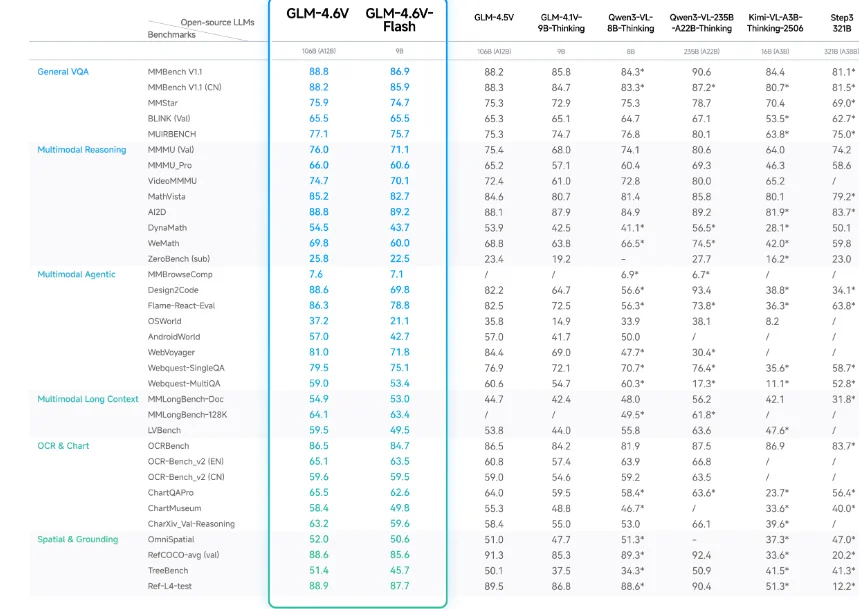
GLM-4.6V has been evaluated on over 20 mainstream multimodal benchmarks, covering general VQA, chart understanding, OCR, STEM reasoning, frontend replication, and multimodal agents.
Main Benchmark Results
| Benchmark | GLM-4.6V | Comparison Model | Description |
|---|---|---|---|
| MathVista | 88.2 | 81.4 (Qwen3-VL-8B) | Mathematical visual understanding |
| WebVoyager | 81.0 | 68.4 (Qwen3-VL-8B) | Agent navigation capability |
| Ref-L4-test | 88.9 | 89.5 (GLM-4.5V) | Spatial localization |
Performance Highlights
- General VQA and Multimodal Reasoning: Strong and stable performance on MMBench, MMStar, MMMU, MathVista, AI2D, and other benchmarks
- Multimodal Agent Evaluation: Excellent performance on Design2Code, Flame-React-Eval, WebVoyager, WebQuest, AndroidWorld, OSWorld, and other tasks
- OCR and Chart Understanding: Demonstrates powerful visual text recognition capabilities on OCRBench, OCR-Bench v2 (Chinese and English), ChartQA, ChartMuseum, and other tests
- Long Context Understanding: Outperforms larger parameter models on MMLongBench-Doc, MMLongBench-128K, LVBench, and other long document tasks
GLM-4.6V (106B) achieves or approaches SOTA levels on MMBench, MathVista, MMLongBench, ChartQAPro, RefCOCO, TreeBench, and other benchmarks among open-source models of comparable parameter scale.
Pricing
GLM-4.6V API pricing:
- Input: $0.30 / 1M tokens
- Output: $0.90 / 1M tokens
Quick Start
Environment Installation
Using SGLang (recommended for video understanding tasks):
       pip install sglang>=0.5.6.post1
pip install nvidia-cudnn-cu12==9.16.0.29
sudo apt update
sudo apt install ffmpeg
Using vLLM:
       pip install vllm>=0.12.0
pip install transformers>=5.0.0rc0
Transformers Quick Example
Here’s a complete example of loading and running GLM-4.6V using the Transformers library:
       from transformers import AutoProcessor, Glm4vMoeForConditionalGeneration
import torch

MODEL_PATH = "zai-org/GLM-4.6V"

# Prepare input messages (supports images and text)
messages = [
    {
        "role": "user",
        "content": [
            {
                "type": "image",
                "url": "https://upload.wikimedia.org/wikipedia/commons/f/fa/Grayscale_8bits_palette_sample_image.png"
            },
            {
                "type": "text",
                "text": "describe this image"
            }
        ],
    }
]

# Load processor and model
processor = AutoProcessor.from_pretrained(MODEL_PATH)
model = Glm4vMoeForConditionalGeneration.from_pretrained(
    pretrained_model_name_or_path=MODEL_PATH,
    torch_dtype="auto",
    device_map="auto",
)

# Process input
inputs = processor.apply_chat_template(
    messages,
    tokenize=True,
    add_generation_prompt=True,
    return_dict=True,
    return_tensors="pt"
).to(model.device)

inputs.pop("token_type_ids", None)

# Generate output
generated_ids = model.generate(**inputs, max_new_tokens=8192)
output_text = processor.decode(
    generated_ids[0][inputs["input_ids"].shape[1]:],
    skip_special_tokens=False
)

print(output_text)
vLLM Deployment
Deploy GLM-4.6V server using vLLM:
       vllm serve zai-org/GLM-4.6V \
  --tensor-parallel-size 4 \
  --tool-call-parser glm45 \
  --reasoning-parser glm45 \
  --enable-auto-tool-choice \
  --served-model-name glm-4.6v \
  --allowed-local-media-path / \
  --mm-encoder-tp-mode data \
  --mm_processor_cache_type shm
Recommended Inference Parameters
To reproduce official leaderboard results, use the following decoding parameters:
       {
    "top_p": 0.6,
    "top_k": 2,
    "temperature": 0.8,
    "repetition_penalty": 1.1,
    "max_generate_tokens": 16384  # 16K
}Notes:
- Use vLLM as the inference backend for optimal performance
- For video tasks, SGLang is recommended for faster and more reliable performance
- Thinking mode is enabled by default in vLLM and SGLang, can be disabled via
extra_bodysettings
Technical Implementation
Model Architecture
GLM-4.6V uses the Glm4vMoeForConditionalGeneration class, a Mixture of Experts (MoE) architecture multimodal conditional generation model. The model is fully integrated into the Transformers library (requires transformers>=5.0.0rc0).
Core Technical Innovations
1. Model Architecture and Long Sequence Modeling
GLM-4.6V extends the training context window to 128K tokens, enabling effective cross-modal dependency modeling in high information density scenarios. To unlock this potential, the team conducted systematic continued pre-training on large-scale long-context image-text data.
Technical Highlights:
- Draws on Glyph’s vision-language compression alignment approach
- Uses large-scale interleaved corpora to enhance synergy between visual encoding and language semantics
- Achieves alignment of visual encoder with 128K context length
2. World Knowledge Enhancement
Introduced a billion-scale multimodal perception and world knowledge dataset during pre-training, covering multi-level concept systems (encyclopedic knowledge).
Performance Improvements:
- Not only improves basic visual perception capabilities
- Significantly enhances accuracy and completeness of cross-modal Q&A tasks
- Strengthens the model’s understanding of real-world concepts
3. Agent Data Synthesis and MCP Extension
GLM-4.6V leverages large-scale synthetic data for agent training. To support complex multimodal scenarios, the team extended the widely-used Model Context Protocol (MCP):
URL-based Multimodal Processing:
- Uses URLs to identify multimodal content passed to and returned from tools
- Addresses file size and format limitations
- Allows precise manipulation of specific images in multi-image contexts
Interleaved Output Mechanism:
- Implements end-to-end mechanism for mixed text-image output
- Adopts “Draft → Image Selection → Final Polish” framework
- Model autonomously calls image cropping or search tools to insert relevant visual elements into generated text
- Ensures high relevance and readability
4. Reinforcement Learning for Multimodal Agents
Incorporates tool-calling behavior into general reinforcement learning (RL) objectives. This aligns the model’s task planning, instruction following, and format compliance capabilities in complex tool chains.
Visual Feedback Loop:
- Explores “visual feedback loop” mechanism
- Model can adjust subsequent behavior based on visual results
- Improves execution accuracy of multimodal tasks
Inference Deployment
The model supports multiple deployment methods:
- Hugging Face Transformers: Standard model loading and inference, suitable for research and prototyping
- vLLM: High-performance inference backend, optimized throughput, suitable for production environments
- SGLang: Optimized for video understanding tasks, provides faster inference speed
- Local Deployment: GLM-4.6V-Flash (9B) version supports deployment on local hardware, reducing hardware requirements
API Calls
GLM-4.6V is compatible with the OpenAI API protocol and supports standard chat completion interfaces. For detailed usage, please refer to Z.ai Developer Documentation.
Four Core Capability Scenarios
According to official introduction, GLM-4.6V excels in the following four core scenarios:
1. Rich Text Content Understanding and Creation
GLM-4.6V can accept various types of multimodal inputs (papers, reports, or slides) and automatically generate high-quality, structured interleaved image-text content in an end-to-end manner.
Key Capabilities:
- Complex Document Understanding: Accurately understands multimodal information in documents containing text, charts, graphics, tables, and formulas
- Visual Tool Calling: During generation, the model can autonomously call tools to crop key visual elements from source multimodal context
- Visual Review and Composition: The model performs “visual review” on candidate images to evaluate relevance and quality, filters out noise, and carefully composes all relevant text and visual content to generate structured, interleaved image-text articles ready for social media or knowledge bases
Practical Applications:
- Automatically generate illustrated summary articles from academic papers
- Convert complex reports into easy-to-read multimedia content
- Automatically extract and reorganize key visual elements from presentations
2. Visual Web Search
GLM-4.6V provides end-to-end multimodal search and analysis workflows, enabling the model to seamlessly move from visual perception to online retrieval, reasoning, and final answers.
Workflow:
-
Intent Recognition and Search Planning
- GLM-4.6V identifies user search intent and determines what information is needed
- Autonomously triggers appropriate search tools (such as text-to-image search, image-to-text search) to retrieve relevant information
-
Multimodal Understanding and Alignment
- The model reviews mixed visual and text information returned by search tools
- Identifies parts most relevant to the query and fuses them to support subsequent reasoning
-
Reasoning and Answering
- Utilizes relevant visual and text clues retrieved from the search phase
- Performs necessary reasoning steps and provides final answers, which are also structured, visually-rich reports
Application Value:
- E-commerce: Search for similar products via images and compare prices
- Travel Planning: Search for attraction images and generate travel guides
- Academic Research: Search for related papers based on charts and generate reviews
3. Frontend Replication and Visual Interaction
GLM-4.6V is optimized for frontend development, significantly shortening the “design-to-code” cycle.
Core Functions:
-
Pixel-level Replication
- By uploading screenshots or design files, the model identifies layouts, components, and color schemes
- Generates high-fidelity HTML/CSS/JS code
- Achieves one-click conversion from design mockups to usable code
-
Interactive Editing
- Users can circle a region on generated page screenshots
- Give natural language instructions (e.g., “move this button to the left and make it dark blue”)
- The model automatically locates and modifies corresponding code snippets
- Supports iterative visual adjustments
Practical Scenarios:
- UI/UX designers quickly convert design mockups to code prototypes
- Frontend developers quickly adjust page styles through natural language
- Product managers describe requirements via screenshots and directly generate usable code
4. Long Context Understanding
GLM-4.6V aligns its visual encoder with 128K context length, giving the model enormous memory capacity. In practice, this is equivalent to processing approximately 150 pages of complex documents, 200 slide pages, or one hour of video in a single inference.
Related Resources
Official Resources
More Articles