The Great Divergence: Why Chinese AI Goes Open While Silicon Valley Locks Down
While OpenAI, Anthropic, and Google build walls around their models, Chinese firms GLM-5.2 and MiniMax M3 go full open-source. Two strategies, one question: who wins the AI war?

Published 105 days ago. Content may be outdated.
Two Worlds, Two Choices
Mid-June 2026 brought a surreal split in the AI world:
-
Silicon Valley: OpenAI, Anthropic, and Google—sworn rivals—form a rare alliance to protect model weights like semiconductor chips. Anthropic even blocks 135,000 developers from using OpenClaw, an open-source tool, forcing users from $200/month subscriptions to $675+/month API billing.
-
China: Zhipu AI open-sources GLM-5.2 on June 13 at 5:21 PM under MIT license. A week later, MiniMax follows with M3. Both are frontier models with 1M-token context windows. Weights? Download freely. Use however you want.
This isn’t coincidence. This is a fork in the road.
GLM-5.2 and MiniMax M3: The Numbers
Let’s see what these “rebels” actually deliver.
GLM-5.2: Zhipu’s Power Move
| Metric | Data |
|---|---|
| Launch Date | June 13, 2026 |
| Parameters | 744B (MoE architecture) |
| Context Window | 1 million tokens |
| License | MIT (most permissive) |
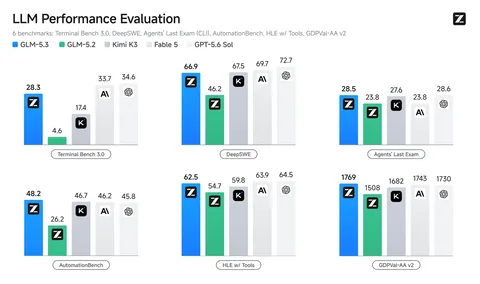
| Key Benchmarks | SWE-bench Verified 77.8% (best open-source) Terminal-Bench 2.0 56.2% |
GLM-5.2’s 77.8% on SWE-bench Verified approaches Claude Opus 4.5 territory—a closed-source flagship. Zhipu frames it as a leap “from Vibe Coding to Agentic Engineering.”
Their Hong Kong stock surged 45% on launch day.
MiniMax M3: The Other Contender
| Metric | Data |
|---|---|
| Launch Date | June 1, 2026 |
| Parameters | 196B total, 11B active |
| Context Window | 1 million tokens |
| Core Innovation | MSA Sparse Attention |
| Key Benchmarks | SWE-Bench Pro 59.0% (beats GPT-5.5) Terminal Bench 2.1 66.0% BrowseComp 83.5 (beats Gemini 3.1 Pro) |
| Cost Edge | Priced at 1/20th of GPT-5.5/Opus |
MiniMax’s killer feature: MSA (MiniMax Sparse Attention), a self-developed sparse attention mechanism. At 1M-token context, it uses 1/20th the compute of full attention, with 9.7x faster prefill and 15.6x faster decode.
And yes, fully open-weight.
What’s Silicon Valley Afraid Of?
The OpenAI-Anthropic-Google “Model Protection Coalition” isn’t theater. They explicitly target China: “Block Chinese firms from distilling our models for free.”
Their playbook includes:
- Sharing intelligence to track suspicious API patterns
- Banning third-party open-source tools (OpenClaw is first, not last)
- Treating model weights as “strategic assets,” comparable to advanced chips
The Anthropic-OpenClaw incident is textbook: users subscribed to Claude, used OpenClaw (an open framework) to call APIs for development. Anthropic killed OAuth access, forcing users to abandon the tool or switch to API billing—tripling monthly costs.
Google followed suit with Gemini restrictions.
The logic is clear: model weights are the moat; open-sourcing is suicide.
What Are Chinese Firms Thinking?
Zhipu and MiniMax’s strategy looks opposite but has its own calculus.
1. Leapfrogging During the Catch-Up Phase
GLM-5.2 and MiniMax M3 compete on benchmarks but lag in ecosystem and brand reach. Open-sourcing is the fastest path to building developer communities and real-world use cases.
Zhipu’s 45% stock jump validates this bet.
2. Cost-Based Disruption
MiniMax M3 costs 1/20th of GPT-5.5. At that price point, open weights hand total control to developers:
- Use their API (cheap)
- Download weights and self-host (cheaper)
- Fine-tune or distill from weights (most flexible)
This trades “openness” for market share, “cheapness” for ecosystem penetration.
3. Technical Confidence
GLM-5.2’s MoE architecture and MiniMax M3’s MSA sparse attention are homegrown innovations. Open-sourcing doesn’t fear “copying” because the architecture itself is the moat—getting the weights doesn’t mean you can wield them.
MiniMax’s MSA is particularly telling: they abandoned it in M2, revived it for M3. This kind of “overthrow-and-revalidate” iteration is the real defensibility.
4. Geopolitical Forcing Function
Timeline matters: two days before GLM-5.2’s open-source drop (June 12), the U.S. government forced Anthropic to shut down Claude Fable over “safety risks.”
Zhipu open-sourcing on June 13 isn’t coincidence. It’s a political statement: you lock down, we open up; you build walls, we tear them down.
Open Source Isn’t Charity—It’s Strategy
Don’t let the word “open-source” fool you. Zhipu and MiniMax aren’t doing charity. They’re playing a bigger game.
Compare the endgames:
Closed-Source Playbook (OpenAI/Anthropic/Google)
- Short-term: Protect tech edge, maximize API revenue
- Long-term risk: Developer ecosystems erode to open models; pricing power vanishes when capability gap closes
Open-Source Playbook (Zhipu/MiniMax)
- Short-term: Forgo weight sales revenue, trade low/free pricing for market share
- Long-term payoff: Developer ecosystems, use cases, data flywheels, ecosystem lock-in
The core question: what’s the real moat in AI models?
If it’s the model weights themselves, closed-source wins. But if the moat is “ecosystem + data flywheel + application scenarios,” open-sourcing might be smarter.
Zhipu and MiniMax’s bet: in a year, model capability will flatten, but ecosystems won’t.
Who Wins?
Too early to call, but a few signals worth watching:
1. Performance gaps in open models are closing fast
- GLM-5.2’s 77.8% SWE-bench Verified nears Claude Opus 4.5
- MiniMax M3 beats GPT-5.5 on coding tasks
- And this is just June 2026 data
2. Developers are voting with their feet
- After Anthropic banned OpenClaw, 135K developers had to migrate
- Zhipu’s stock jumped 45% on open-source day—markets voting with real money
- MiniMax M3 got instant integration from tools like MonkeyCode
3. Cost advantages are reshaping markets
- MiniMax M3 costs 1/20th of closed models
- Not a discount—a demolition
- When performance gaps shrink to 10%, a 20x price gap means everything
4. Geopolitics will keep escalating
- America’s “Model Protection Coalition” won’t stop
- China’s “open-source insurgency” won’t stop
- This isn’t about tech philosophy—it’s about ecosystem dominance
Final Thought
Silicon Valley is turning AI models into semiconductor-like strategic assets, protecting tech edges with walls. Chinese firms are tearing down walls, trading openness for ecosystems.
Two strategies. No right or wrong. Only winners and losers.
But one thing’s certain: when OpenAI, Anthropic, and Google build walls together, Zhipu and MiniMax chose a different path—not because they’re more generous, but because they believe the future of AI isn’t in model weights. It’s in developers’ hands.
A year from now, we’ll know who bet right.
Sources:
More Articles