Musk's $600B Cursor Acquisition! Historic $100B 'Breakup Fee' - xAI's Coding Power About to Skyrocket
Musk's SpaceX strikes $600B acquisition option with AI coding unicorn Cursor, or pay $100B breakup fee. xAI fills coding gap, Cursor gains Colossus compute. Full analysis.
Published 160 days ago. Content may be outdated.
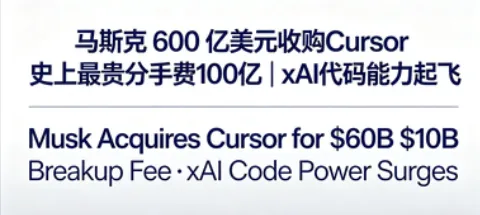
Elon Musk strikes again! On April 21, 2026, SpaceX officially announced a deal with AI coding unicorn Cursor — a $600 billion acquisition option, or pay $100 billion in collaboration fees if not executed.
What does this mean? This is one of the most expensive “breakup fees” in corporate history, and a landmark event signaling that the AI application layer acquisition war has entered white-hot territory.
Even more striking: this deal conceals Musk’s triple play — filling xAI’s coding gap, cutting off competitors’ access, and hyping SpaceX’s epic IPO.
Deal Structure: $600B or $100B - History’s Most Expensive “Either-Or”
First, look at the core terms of this deal:
| Deal Element | Details | Notes |
|---|---|---|
| Acquisition Option | $600 billion | SpaceX can acquire Cursor outright at this price in H2 2026 |
| Collaboration Fee (Breakup Fee) | $100 billion | If acquisition not executed, SpaceX must pay this fee |
| Compute Support | Colossus supercomputing cluster | Hundreds of thousands of NVIDIA GPUs, world-class compute |
| Collaboration Goal | Build world’s strongest coding AI | Combining SpaceX compute + Cursor application capabilities |
Simply put, Musk “reserved” Cursor with $600 billion, and if he backs out, he pays $100 billion. This “breakup fee” figure already exceeds the valuation of most AI startups.
Why Is Musk Dropping Big Money on Cursor?
1. Filling xAI’s Code Generation Gap
Background: In February 2026, Musk merged his AI company xAI into SpaceX, with a combined valuation of $1.25 trillion.
Problem: Musk publicly admitted that xAI lags behind OpenAI and Anthropic in code generation tools.
Action Timeline:
| Time | Event | Significance |
|---|---|---|
| February 2026 | xAI merged into SpaceX | Combined valuation $1.25 trillion |
| March 2026 | Poached two core engineering leads from Cursor | Andrew Milich and Jason Ginsberg, to rebuild coding capabilities |
| April 21, 2026 | Reached $600B acquisition option agreement | Directly buying the entire company |
From poaching talent to buying the company, Musk’s moves are seamless. Cursor has accumulated an extremely large developer user base in the “natural language programming (Vibe Coding)” space — exactly what xAI lacks most.
2. Cutting Off Competitors’ Access
How hot is Cursor:
- One of the fastest-growing AI startups in recent years
- Before the deal, seeking new funding round at over $500 billion valuation
- Giants like NVIDIA interested in investing
Musk struck decisively, intending to bind this top traffic gateway to his xAI/Grok model ecosystem, preventing it from going to OpenAI or Anthropic.
The data doesn’t lie: Cursor’s developer user base means massive code training data and real-world usage feedback, crucial for AI model iteration.
3. Hyping SpaceX’s IPO of the Century
Here’s the key: SpaceX is currently preparing for what could be an initial public offering (IPO) in late 2026.
Bundling the currently red-hot AI coding unicorn with its aerospace and AI model businesses will undoubtedly provide powerful capital narrative and valuation support for this potentially record-breaking IPO.
| IPO Element | Value |
|---|---|
| Aerospace | SpaceX reusable rocket technology |
| AI Models | xAI/Grok model ecosystem |
| AI Applications | Cursor developer tools (newly added) |
| Compute Foundation | Colossus supercomputing cluster |
This is a complete AI full-stack story: from compute to models to applications, forming a closed loop.
What Does Cursor Get? Top-Tier Compute Boost
Cursor isn’t losing out either. According to the agreement, Cursor will gain access to SpaceX’s massive compute resources — particularly its supercomputing cluster “Colossus” with hundreds of thousands of NVIDIA GPUs.
What compute means:
- Larger-scale model training
- Faster inference speeds
- Stronger multimodal capability expansion
Simply put, Cursor’s AI capabilities can be maxed out directly.
Industry Significance of This Deal
Model Giants Begin Acquiring Top Applications
This deal marks that the war by model giants to acquire top AI-native applications has entered white-hot phase.
Previous landscape:
- Model companies (OpenAI, Anthropic, Google) provide foundational capabilities
- Application layer companies (Cursor, Midjourney, Notion AI) build products on models
Current trend:
- Model companies directly acquiring or investing in top applications
- Forming vertical integration from models to applications
AI Coding Tools Become Battleground
Why Cursor? Because code generation is the litmus test for AI capabilities:
- Requires precise logical reasoning
- Requires understanding complex context
- Requires generating executable results
- Has clear right/wrong standards (does it run?)
Whoever leads in code generation leads in AI capabilities.
$600B Defines Valuation Ceiling for AI Applications
Cursor’s $600 billion valuation (acquisition option price) sets a new valuation benchmark for AI application layer companies.
Compare:
- Cursor’s previous funding valuation: over $500 billion
- SpaceX acquisition option price: $600 billion
- Collaboration fee if not acquired: $100 billion
This means top AI applications’ valuations can now rival model companies.
Final Thoughts
Musk “reserved” Cursor with the stunning $600 billion/$100 billion bet — this isn’t just his shortcut to frantically strengthen AI coding capabilities, but also a signal that the AI industry is entering a new phase.
It’s no longer about “having an AI feature” to call yourself an AI company, but achieving: from compute to models, from models to applications, forming a complete closed loop.
SpaceX + xAI + Cursor + Colossus — each of these capabilities is strong individually, but combined they’re a dimensional strike.
More importantly, this deal tells all AI entrepreneurs: the value of the application layer may be bigger than we imagined.
The future of AI coding may come faster than we think.
More Articles